Before they became a summer escape for Istanbulites, and long before exiled princes gave them their name, the Princes’ Islands were something simpler; a cluster of quiet, rocky hills rising from the sea.
Geologically, they’re the product of millions of years of tectonic drama. Blame the North Anatolian Fault that nudged and ground the earth for ages, pushing these islands up from the seabed of the Marmara. That’s why they’re hilly, forested, and covered in layers of sediment and ancient rock.
The first humans showed up long before there were any maps. Archaeologists have found stone tools and pottery shards near Büyükada and Burgazada. They are nothing grand but enough to suggest that prehistoric people stopped here to fish, rest, or take shelter. Think of it as the archipelago’s soft opening: no cities, no temples, just a few clever wanderers passing through.
Princes’ Islands in Byzantine Times
Things got more interesting around the 7th century BCE, when the Greeks from Megara founded Byzantium across the water. As that city grew, they spread out to these islands, making a home among the pine trees and sea. Fishing, vineyards, fruit gardens, and vegetable patches dotted the landscape.

By the 4th century CE, monks seeking solitude began arriving, drawn by the islands’ remoteness and stillness. They built monasteries and chapels, dug cisterns into the hills, and cultivated the earth with care. The islands became a spiritual refuge and a retreat from the noise of the capital, offering a chance to turn inward.
At the same time, the islands took on a new and lasting role: exile. For the Byzantine elite, they offered a perfect solution – close enough to keep watch, yet far enough to forget. Emperors exiled rivals, bishops, and even empresses across the water to quietly remove them from the game of power.
The first recorded exile was Armenian bishop Nerses I, banished to Büyükada by Emperor Constantine the Great. Later, Empress Theodora was confined to a convent here – most likely the Monastery of St. Petrion. She remained there until a popular uprising forced Emperor Michael V to flee, elevating her once more to the throne as Empress. In time, the frequent exile of royals to the islands gave the archipelago its modern name: the Princes’ Islands.
Ottoman Rule on the Princess Islands
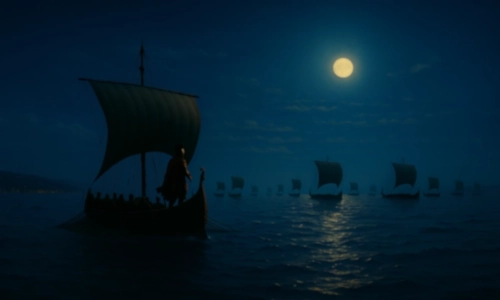
When the Ottomans arrived, Admiral Baltaoğlu Süleyman Bey seized the islands in April 1453 with a fleet of thirty galleys. But for centuries afterward, the archipelago remained largely untouched by Ottoman ambitions. It retained its distinctly Greek character, featuring fishing villages, monasteries, and churches tied closely to the Greek Orthodox Patriarchate. The peaceful rhythm was briefly shaken in 1562 when a plague swept Istanbul, driving Christians to seek refuge in the island monasteries.


By the early 1800s, the islands had a distinctly Greek character; fishing villages, vineyards, and stone chapels nestled between pine groves. That character deepened in 1825, when fishermen from Marmara towns like Karamürsel, Mudanya, Gemlik, and Darıca, along with olive farmers from Lesbos and Chios, began settling here. The archipelago, always something of a retreat, now echoed with Aegean accents and island rhythms.
The real transformation came in 1846, with the arrival of steam-powered ferries. Suddenly, the Princes’ Islands were within easy reach of Istanbul, and the city’s aristocracy caught on fast. Beautiful mansions sprang up, and the islands turned into a multicultural summer retreat where Turkish pashas, Greek merchants, Armenian bankers, and Levantines might all share the same sunset.
What had once been a quiet refuge began to reflect something else: the empire’s shifting gaze toward modernization. Hotels and cafés opened; casinos and opera houses followed. Art exhibitions, summer concerts, and garden soirées brought a new kind of rhythm to island life: cosmopolitan, seasonal, and distinctly modern.

In 1867, the archipelago was granted its own municipality – the second in Istanbul after Beyoğlu. It was more than a bureaucratic step: it signaled the islands’ new role as a showcase for the empire’s westernization project. Institutions soon followed; Heybeliada’s Naval Academy, Elen Trade School, and Greek Orphanage, each embodying the spirit of modernization and progress.
Beyond the grand transformations on the main islands, the smaller islands had their own compelling stories. Sedef Island was granted to Tophane Marshal Damad Ferid Pasha in 1850. He planted olive trees, grew vegetables, and tried to tame its wilderness. But after his death, the island was neglected — and during World War I, its trees were cut down, leaving it barren once again.

Yassıada’s fate was more dramatic. In 1858, British ambassador Sir Henry Bulwer bought the island with dreams of vineyards, orchards, and neo-Gothic mansions. But his “castle,” wrapped in ivy and gossip, became a liability. Istanbul newspapers whispered of British plans to turn the island into a military outpost. Overwhelmed by expenses and suspicion, Bulwer eventually sold it to the Khedive of Egypt, Ismail Pasha. The mansion stood in ruins until the 1950s — a ghost of imperial eccentricity.
A New Century, A New Chapter for the Islands


The 20th century brought big changes. In the wake of the 1917 Russian Revolution, a group of White Russians settled on the islands. They opened pastry shops, casinos, and beaches, thereby leaving a lasting mark on the islands’ emerging recreational culture.
But other movements were less voluntary. The deportation of Armenians in 1915 and the Greek-Turkish population exchange of 1924 triggered sudden demographic shifts. Many of the island’s original inhabitants were forced to leave, and their abandoned homes were given to Turkish migrants arriving from Thessaloniki, Crete, and elsewhere.
From 1950 onwards, the islands underwent further demographic shifts. The Istanbul Pogrom of September 6–7, 1955, the Cyprus conflict of 1974, and the 1980 military coup all accelerated the exodus of Istanbul’s non-Muslim minorities. Many Greek islanders left Turkey altogether, taking with them generations of memory and culture.
In their place came new waves: from the 1960s through the 1980s, internal migration from Anatolia brought new residents to the islands, increasing the population once again and significantly altering the islands’ social fabric. The Princes’ Islands — once the summer enclave of empire — were now becoming a microcosm of the modern republic: diverse, transitional, layered.
But beneath these changes, the Princes’ Islands never lost their essence: a peaceful, timeless escape just an hour from Turkey’s largest city.
Ready to experience it for yourself? Check out our complete guide for first-time visitors.
Leave a Reply