Where the Bosphorus splits two continents, stories move like mist across the water, unseen yet felt everywhere. Some trace back to when gods roamed the earth, and fate was written in the stars. Others go back to the city’s earliest days as Byzantium.
Still more live on in the memories of local families: a sultan’s vision, a flying Hezarfen, or a beautiful princess bitten by the snake. Here are the most famous Istanbul legends and myths — tales that still haunt the city.
The Fairy Legend of Istanbul
Long ago, before empires rose and fell, the world belonged to the “Peri” – fairies from ancient Turkish legends. They danced in the wind, brought life to the forests with their laughter, and made flowers bloom with their songs.

Among them were two fairies in love, their joy as bright as the moon shining over the Bosphorus. But even fairy love can be complicated. The bride’s father would not grant his daughter’s hand lightly.
Before the wedding, the groom’s father had to build a palace of impossible beauty – one that would stand in the most sacred, most breathtaking place on earth.
The groom’s father, versed in fairy magic, traveled far – across green valleys, over sheer mountains, and along forgotten coasts. Yet nothing felt right. Until he found a place where the Bosphorus shimmered between two worlds, and the horizon blurred like a dream.
He raised a palace from the ground, with marble that shone like moonlight. Tall towers reached the clouds, their tips sparkling like stars. Gardens? Their scent could make even gods dizzy. In the center stood a throne room, glowing with magic.

When the fairy king saw it, even he was stunned. The palace was beyond anything he had imagined. He gave his blessing.
So the city of Istanbul was born – created from love, and touched by fairy magic.
But as humans came, with fire and iron, the fairies cursed the Bosphorus, turning its waters wild and angry. Storms raged, and ships broke apart.
Still, Istanbul could not be destroyed. Divine powers — some say angels, others say ancient gods — broke the curse. The fairies vanished. Istanbul remained beautiful and eternal.
Io and ZEUS AND the LEGEND of the Bosphorus
In an age when gods still walked the earth and fate was woven with desire, Zeus, lord of the skies, desired Io, radiant daughter of Inachus, river-king of Argos.

Hera, Zeus’s ever-watchful queen, felt betrayal stir in the winds and followed him to the mortal realm. Sensing her approach, Zeus transformed Io into a cow.
Captivated by the animal’s unearthly grace — and more by her intuition — Hera claimed her as a gift. No refusal possible, the cow changed hands.
Io was entrusted to Argus Panoptes — the all-seeing guardian whose hundred eyes never all slept. By day she grazed in fields; by night he confined her beneath stone and silence.
Zeus sent Hermes to set Io free. Disguised as a shepherd, Hermes played a melody so soft that Argus’s eyes closed one by one. When the last dimmed, Hermes struck — and Io was freed.

Hera’s wrath endured. She sent a monstrous gadfly to sting Io into madness, driving her to wander the earth in frenzy.
Io galloped across the Ionian Sea, fled the wild hills of Thrace, and leapt between continents at the narrow strait that would one day bear her name — Bosporos, the Cow’s Ford.
She reached the sacred banks of the Nile, where Zeus destroyed the fly and lifted her curse. Beneath the Egyptian sun, she was restored to her human form.
Io later bore a child, Keroessa, whose son, Byzas, would sail to the place where his grandmother once crossed — and found Byzantion.
kING Byzas and the Foundation of Byzantium
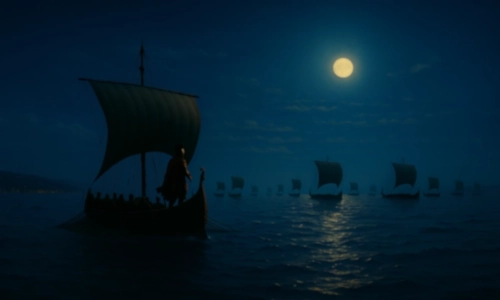
When the world was still wild and cities were whispers in men’s minds, a prince named Byzas set sail from Megara. His quest: to find the land worthy of legend, where sun and sea would forge an empire.

The gods had spoken through the Oracle of Delphi, her voice trembling with prophecy: “Seek the land across from the blind.”
With the salt wind in his hair and the stars as his guide, Byzas led his ships into the unknown. Days turned to nights, until at last, the Bosphorus unveiled itself. The air hummed with destiny and the waves murmured secrets.
To his right lay Chalcedon, a city already claimed. To his left, untouched earth — emerald hills that rolled like living waves, crowned by forests shimmering in gold light, and a shore kissed by waters brighter than silver.

Chalcedon was the “blind” city. Its founders had stood upon these very shores and failed to see the truth before them: The greatest destiny lay not where they stood, but across the water.
And so, the legend was born: Byzas, the prince who listened to the gods, became the father of a city that would wear many names, outlive many empires, and become the crossroads of history itself.
Serpent legend and the Maiden’s Tower
Long ago, in the heart of Byzantium, an emperor’s joy was unparalleled as the birth of his daughter brought light to his empire. Her beauty shone like the first rays of dawn over the Bosphorus, and the emperor’s heart swelled with pride.

This light soon faced eclipse. An oracle, summoned to peer into her future, delivered a prophecy that cast a shadow over the empire: “On her 18th birthday, she will die, bitten by a venomous serpent.”
Horrified by this fate, the emperor vowed to defy destiny itself. He commanded the construction of a tower on a small islet on the Bosphorus, isolated and surrounded by water, thus away from the reach of any snake.
There she grew, graceful and radiant, untouched by danger. As her 18th birthday drew near, the emperor believed he had outwitted destiny. To celebrate, he presented her with a basket of exotic fruits from the palace gardens – unaware it concealed a hidden snake.

As the girl reached for a fig, the serpent struck. The prophecy was fulfilled. The emperor’s daughter died in his arms, in the very tower that was meant to save her.
Thus the tower became known as the Maiden’s Tower – a solemn reminder that no matter how fiercely one fights fate, it can never be outrun.
Sultan’s Dream and the Suleymaniye Mosque
One night, Sultan Suleiman slept deeply in his chamber at Topkapı Palace. But his rest was interrupted by something extraordinary.
The Prophet Muhammad appeared to him and revealed the exact spot where the grand mosque Suleiman had been contemplating should be built.

The vision went further still — down to the smallest details. The Prophet instructed him precisely about the position of the minbar (pulpit), the mihrab (prayer niche), and the kürsü (pulpit).
When Suleiman awoke, tears filled his eyes. At dawn, he hurried to the dream’s location and summoned Mimar Sinan, declaring his intention to build the mosque there.
Sinan, as if expecting this moment, greeted him with a quiet smile. “My Sultan,” he said, “we shall build the mosque thus: the pulpit here, the prayer niche there, and the pulpit over yonder.“

Suleiman paused, struck by awe and certainty. A smile crept across his face. And Sinan, bowing his head with humility and grace, said: “My Sultan… I was there, just two steps behind you.”
Sultan Suleiman ordered construction to begin without delay. Architect Sinan, ready with his plans, laid the first stone with blessings from Shaykh al-Islam Ebussuud Efendi.
Thus began the making of a sacred monument destined to stand for centuries.
Hezarfen Ahmed celebi and the Galata Tower
In the time of Sultan Murad IV, when the empire stretched from the Danube to the deserts of Arabia, it is said that the sky over Istanbul carried a man.

It was the 17th century, and the capital Istanbul buzzed with celebration. Crowds had gathered for the wedding of the Sultan’s daughter. Music filled the air, roasted almonds scented the streets, and ships with silk sails glided on golden waters.
Then all eyes turned to Galata Tower. The streets hushed – traders, imams, fishermen, children – all looking up.
Because at its summit stood a man with wings, crafted from eagle feathers, wood, and wax. He was Ahmed Çelebi. The people called him Hezarfen, “the man of a thousand sciences”, for the depth of his knowledge.
For years, he had studied the flight of birds, testing wings in the open fields of Okmeydanı. And now, the stage was set for his final. As the crowd held its breath and the Sultan watched from the Topkapı Palace, he leapt into the Istanbul air.

At first, he fell. Then the wind caught him. He soared over the Bosphorus, gliding above domes and courtyards, past minarets and masts, before landing in the Doğancılar area of Üsküdar.
The crowd erupted in a frenzy. Some swore it was a miracle, and even the stern Sultan was astonished. He rewarded Hezarfen with a sack of gold, but he also grew uneasy. A man who could fly, the Sultan feared, might one day fly too far.
So Hezarfen Ahmed Çelebi was quietly exiled to Algeria. There, far from the domes of Istanbul, the man who once flew lived and died.
Leave a Reply