Constantinople was founded in 330 AD by Emperor Constantine the Great as the new capital of the Roman Empire. Situated between Europe and Asia, it quickly became the heart of Byzantine civilization and a major center of medieval culture.
Today, modern Istanbul still bears the marks of this rich heritage. In historic areas such as Fener, Balat, Zeyrek, and the Princes’ Islands, visitors can explore Byzantine monuments with red brickwork, intricate mosaics, and golden decorations. Surviving city walls and water structures continue to shape Istanbul’s architectural landscape.
Wandering through Istanbul’s neighborhoods, you’ll encounter some of the most remarkable examples of Byzantine architecture.
Hagia Sophia

Built in 537 under Emperor Justinian, Hagia Sophia was the world’s largest cathedral for nearly a thousand years. It served as the spiritual heart of Constantinople.
Hagia Sophia’s 30-meter-wide central dome appears almost weightless and redefines the architectural possibilities of the Byzantine era. Inside, visitors can see Christian mosaics and Islamic calligraphy coexisting across centuries. They reflect Hagia Sophia’s evolution and its lasting influence on Byzantine, Ottoman, and world architecture.
Over the centuries, Hagia Sophia has served as a church, mosque, and museum. Today, it functions again as a frequently visited mosque in Sultanahmet, while remaining one of Istanbul’s top tourist attractions.
Chora Church

Chora Church in Edirnekapı is known for its intricate mosaics and frescoes, offering a more intimate experience than Hagia Sophia.
Originally a 4th-century monastry, the current structure mostly dates to the 11th and 14th centuries. Its vaults and domes are filled with vivid scenes from Christ’s life, creating a rich visual experience.
Like Hagia Sophia, Chora Church now serves as a mosque and continues to attract visitors interested in Byzantine heritage. Together with the historic Walls of Istanbul and the Mihrimah Sultan Mosque, it forms part of a dense cluster of important historical landmarks.
Pantokrator Monastery

The former Pantokrator Monastery, now Zeyrek Camii, is a key example of Byzantine architecture. Constructed in the 12th century by Emperor John II Komnenos and his wife Irene, the complex originally included a monastery, a hospital, and an imperial mausoleum.
With refined brickwork and rhythmic arches, it stands as a rare example of Middle Byzantine design that has endured despite centuries of weathering.
Located in the Zeyrek neighborhood near Atatürk Boulevard, the complex now functions as a mosque while remaining an important historical site in Istanbul.
Monastery of Stoudios

Dating back to the 5th century, the Monastery of St. John the Forerunner of Stoudios is the oldest surviving church in Istanbul. It served as the spiritual center of the influential Studite monastic order.
Its basilica plan, timber roof, and austere layout reflect a pre-Justinian vision of sacred space, before domes became dominant in Byzantine church design.
Now in ruins, the monastry in Yedikule awaits full restoration. Despite this, its structure still shows the design principles and style of early Byzantine architecture.
Theodosian Walls

The Theodosian Walls were among the most formidable fortifications of the ancient world. They stretch nearly seven kilometers across the city’s western edge.
Built in the 5th century under Emperor Theodosius II, the triple-layered defenses combined massive stone ramparts, moats, and towers. For over a thousand years, they protected the city against countless sieges.
Today, visitors can explore the best-preserved sections at Edirnekapı near Chora Church or at Yedikule Fortress.
Valens Aqueduct

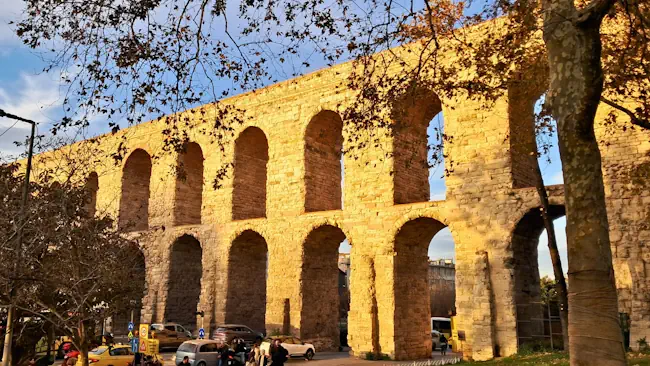
Completed in the late 4th century under Emperor Valens, the Valens Aqueduct was crucial for supplying water to Constantinople. It stretched more than 900 meters within the city walls.
The aqueduct is one of the most prominent landmarks in Istanbul’s Old City. The best view is from Saraçhane Park, where it bridges Atatürk Boulevard in Fatih. From here, near the Şehzade Mosque, visitors can fully appreciate its monumental scale.
Basilica Cistern

Beneath the bustling streets of Sultanahmet, near the Blue Mosque and Hagia Sophia, lies the Basilica Cistern.
Built in the 6th century under Emperor Justinian, the underground reservoir measures roughly 140 by 70 meters. It could hold up to 80,000 cubic meters of water. The space is supported by 336 marble columns, many of which were repurposed from earlier temples. Among its most enigmatic features are two Medusa heads serving as column bases.
For a quieter experience, visitors can also explore the nearby Cistern of Philoxenos and the Theodosius Cistern.


Leave a Reply