Galatasaray Museum is one of Beyoğlu’s most meaningful cultural stops.
Located just across from the historic Galatasaray High School, this two-floor museum captures the deep connection between the school and the legendary Galatasaray Sports Club.
Here, classrooms and stadiums share the same story, their histories intertwined in halls filled with spirit and pride.
The museum itself traces that story in detail, offering visitors a clear view of how Galatasaray’s legacy has been preserved.
Galatasaray Post Office Building
The building that houses the Galatasaray Museum today was first commissioned in 1875 by Armenian entrepreneur Theodor Sıvacıyan as his private residence.
Built in a neoclassical style, it stood out with French-imported doors and ceilings painted by Italian artists—a reflection of Beyoğlu’s cosmopolitan and elite character at the time.
Yet beneath the opulence, its ground floor functioned as a pharmaceutical laboratory—an early example of scientific enterprise in the Ottoman Empire.

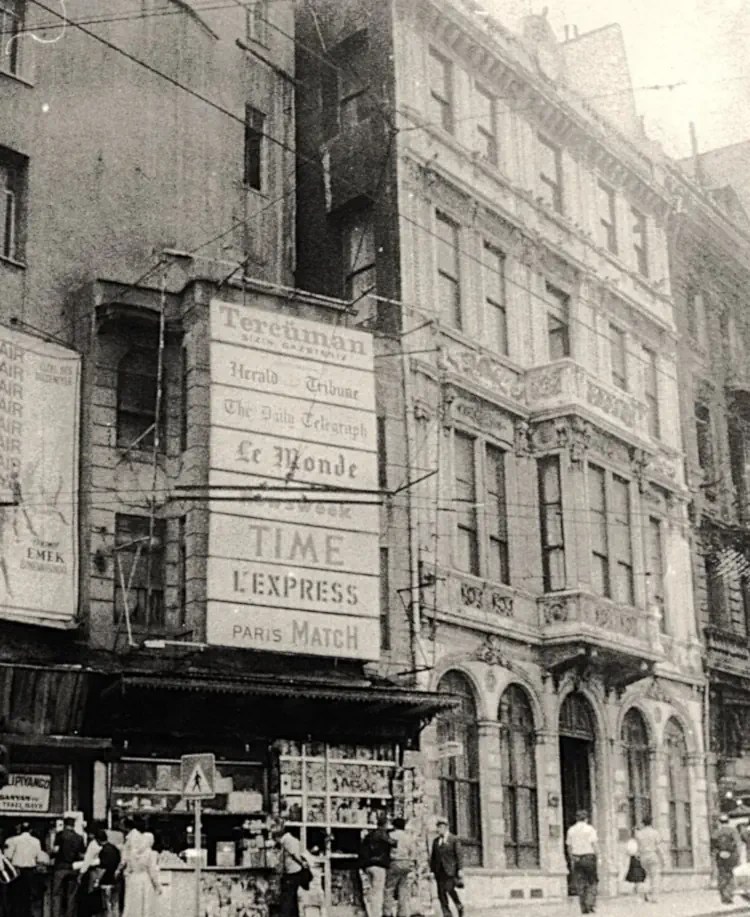
In 1907, the Ottoman state acquired the building and converted it into the Galatasaray Post Office and Telegram Ministry.
Following the fall of the empire, it became a hub of international media, hosting the BBC, German radio, and Istanbul Radio.
The building had suffered several fires over the years, but the most devastating came in 1977, causing significant damage. Although restorations followed, much of its original splendor was lost.
Today, the building lives on as the Galatasaray University Culture and Arts Center, honoring the past while inviting new generations to explore it.
Galatasaray Museum

Long before Galatasaray was a name shouted across football stadiums, it was first a school.
The story begins in 1481, with the founding of the Galata Sarayı Enderun-u Hümayunu, an Ottoman imperial academy.
Centuries later, in the 19th century, it was reshaped by the Tanzimat reforms. The result was Galatasaray Lycee: a bold blueprint for Turkey’s future.
It was a place where East met West, where a classical Ottoman education collided with Enlightenment ideals. Beyond science and facts, students were learning how to think freely, question authority, and imagine a different future.

Today, the first floor of the museum pays homage to that educational legacy.
Textbooks sit under glass beside finely embroidered student uniforms. Sepia-toned photographs line the walls; some show the faces of future poets, presidents, and playwrights. These were the intellectuals who shaped a fledgling republic on the brink of transformation.
Downstairs, the quiet legacy of learning; upstairs, the thunder of the stadium. This is the world of football, of Galatasaray SK, born from the dreams of schoolboys and forged on muddy fields into a national legend.
It was a time when foreign clubs dominated Istanbul’s football scene, just as they did the empire’s politics, economy, and culture.
A group of students from Galatasaray High School, led by Ali Sami Yen, set out to defy them. What began as a schoolyard dream quickly caught fire, growing into a movement, and the first Turkish football team in 1905.
Next, they started competing in the Istanbul Football League.

Since then, Galatasaray has become Turkey’s most decorated football team, with 25 league titles, countless domestic trophies, and European glory, including the iconic UEFA Cup victory in 2000.
Inside the museum’s halls, trophies and worn jerseys sit beside wax figures of legends like Ali Sami Yen and Metin Oktay. Together, they create a powerful shrine to Galatasaray’s enduring legacy.
Ali Sami Yen: Galatasaray’s Visionary Student
Ali Sami Yen was born in Kandilli, a scenic neighborhood overlooking Istanbul’s Asian shore.
The son of Sami Frashëri, a distinguished Albanian intellectual and writer, Ali Sami grew up surrounded by ideas of culture, progress, and national pride.
As a student at Galatasaray High School, Ali Sami Yen was captivated by the growing passion for football.
He gathered a group of like-minded classmates like Asım Tevfik Sonumut and Abdurrahman Robenson, Turkey’s first left-wing back who tragically fell in World War I.
Together, in 1905, they founded Galatasaray SK within the walls of a modest classroom.

Ali Sami Yen didn’t just lead as president; he coached the team, organized early matches, and even helped sew the club’s first red-and-yellow jerseys.
Despite limited resources and widespread skepticism, the team quickly made its mark by defeating established foreign clubs.
With Ali Sami Yen’s vision at its core, this fledgling team grew into one of Turkey’s most legendary football dynasties.
The Crownless King: Metin Oktay
Metin Oktay, known as ‘Crownless King’ (Taçsız Kral), is a true legend in Turkish football.
Born in 1936 in İzmir, Metin Oktay joined Galatasaray in 1955, quickly becoming the club’s heart and soul.

His remarkable goal-scoring ability made him the top scorer for seven consecutive years, a record that cemented his place in history.
He scored over 200 goals for the club, a feat only a handful of players such as Tanju Çolak and Hakan Şükür have since managed to match.
However, Oktay’s impact wasn’t just on the pitch. His leadership, passion, and dedication turned him into a symbol of Galatasaray’s pride.
His number 10 jersey and unforgettable goals remain etched in the club’s soul. Even today, children know his name and mimic his strikes. I saw one kid.
Why Visit? After exploring its halls, step outside and Istiklal is as always. But something feels different. Either it’s the echo of a school bell from centuries past or the roar of a crowd after a last-minute goal. Either way, you’ll walk away seeing Istanbul differently.
Leave a Reply